
Gasket mount has become one of the most common terms on modern mechanical-keyboard product pages. It is often presented as a premium feature, but the name alone does not tell you whether a keyboard will actually feel or sound better. A gasket-mounted board changes how the plate and PCB are supported inside the case, which can affect stiffness, vibration and acoustics—but switch choice, plate material, foam, keycaps and case construction still matter just as much.
What is a gasket-mounted keyboard?
In a conventional tray-style design, the PCB or plate is usually screwed directly into mounting points in the case. A gasket-mounted keyboard instead supports the plate or PCB through softer material—commonly foam, silicone or Poron strips—positioned between the assembly and the case. The goal is to reduce hard contact points and allow the typing assembly to move or flex slightly rather than transferring every keystroke directly into the chassis.
| Mounting style | How the assembly is supported | Typical effect |
|---|---|---|
| Tray mount | PCB/plate fixed directly to case posts | Usually firmer with more direct case contact |
| Top mount | Plate secured around the upper case | Controlled, often consistent feel |
| Gasket mount | Plate/PCB cushioned between soft gasket material | Can reduce harshness and vibration and allow more flex |
What does gasket mount change in actual use?
- Typing feel: the board can feel slightly softer because the plate assembly is not clamped as rigidly against the case.
- Vibration: softer mounting points can reduce some vibration travelling into the chassis.
- Sound: less direct case contact can help create a more controlled sound, especially when paired with sensible internal dampening.
- Flex: some gasket implementations allow visible plate movement, while others are intentionally much firmer.
- Consistency: good gasket placement can make the board feel more even across different areas of the keyboard.
AULA F75: why gasket mount works well in an all-round keyboard
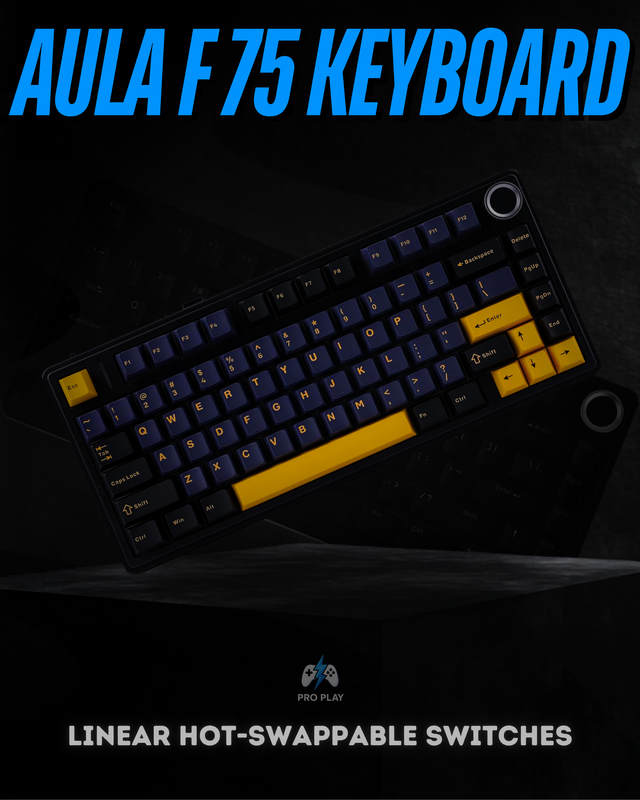
The AULA F75 is a practical example of why gasket mounting became popular. Its 75% layout combines a gasket-mounted structure with hot-swappable linear switches, tri-mode connectivity, RGB lighting and a 4000mAh battery. The important point is that the mount is only one part of the experience: the switches, internal dampening and keycaps all work together to determine how the keyboard actually feels.
View AULA F75Gasket mount and foam are not the same thing
This distinction matters when comparing specifications. Gasket mount describes how the typing assembly is supported. Foam and silicone layers describe acoustic dampening inside the case. A keyboard can use gasket mounting with very little foam, or it can combine gasket mounting with several dampening layers. The AULA F87 Pro, for example, pairs a gasket structure with five layers of sound-absorbing material, while the Attack Shark X820 Ultra also lists an upgraded gasket mount with five-layer acoustic foam.
 View Attack Shark X820 Ultra
Why gasket mount does not automatically mean better
Two gasket-mounted keyboards can feel completely different. A thick aluminium plate can make one board feel firm, while a thinner polycarbonate plate can allow more flex. Heavy case foam can make sound more muted, while a lighter build may sound more open. Switch spring weight, stabilizers and keycap material can also change the experience more than the mounting label itself.
Who benefits most from a gasket-mounted keyboard?
- Users who prefer a softer, less rigid typing feel.
- People who care about keyboard acoustics and want less case vibration.
- Enthusiasts who plan to change switches and tune the board over time.
- Gamers who also type or work for long periods and want a more refined overall feel.
- Anyone comparing two similarly equipped keyboards where mounting structure becomes a useful tie-breaker.
Current gasket-mounted keyboards in the ProPlay catalogue
Current examples include the Royal Kludge R87 Pro, which combines a gasket mount with pre-lubed linear switches, hot-swap support and internal sound absorption; the Royal Kludge R98 Pro, which uses a 96% layout with five-layer dampening; and the AULA Win68 HE Max, which combines gasket mounting with Hall Effect switches and an 8000Hz polling rate. The mounting style stays relevant across mechanical and magnetic keyboards, but it affects feel and acoustics rather than the electrical speed of the switches.
Is gasket mount worth paying extra for?
If two keyboards are otherwise similar, gasket mount can be a worthwhile advantage—especially if you care about typing feel and sound. But if choosing between a gasket board with weak switches or poor layout and a non-gasket board that better suits your use, choose the better overall keyboard. Mounting structure should refine the buying decision, not control it.
If you are still deciding what type of keyboard you need, start with How to Choose a Mechanical Keyboard and our 75% vs 65% vs 60% layout guide. For switch upgrades, read Hot-Swappable Keyboards Explained, or browse current gaming keyboards.