
Hall Effect and TMR sticks are both designed to solve one of the most frustrating controller problems: stick drift caused by wear in traditional potentiometers. Both use magnetic sensing, but they do it differently. For most buyers, the important question is not which acronym sounds newer—it is how the stick feels, how accurately it tracks and what other features the controller combines with it.
How traditional sticks develop drift
Traditional analog sticks commonly use potentiometers with physical contact surfaces. As those parts wear, the controller may begin reporting movement even when the stick is centered. That is what players usually call stick drift. Hall Effect and TMR designs reduce reliance on that same contact-based sensing method by measuring magnetic changes instead.
Hall Effect vs TMR at a glance
| Feature | Hall Effect | TMR |
|---|---|---|
| Sensing method | Measures magnetic field changes | Measures magnetic resistance changes |
| Physical sensing contact | No traditional potentiometer contact | No traditional potentiometer contact |
| Main attraction | Mature anti-drift magnetic technology | High precision and efficiency in newer designs |
| Availability | Already common in gaming controllers | Still less common, but growing |
| Examples at ProPlay | EasySMX D05, X05 Pro, X15 Wukong | EasySMX X20, EasySMX D-10 |
Hall Effect: the established magnetic option
Hall Effect sticks use a magnet and sensor to measure joystick position without relying on the same rubbing contact surface found in a traditional potentiometer. That is why they are commonly marketed as anti-drift or drift-resistant. The EasySMX D05 uses Hall Effect joysticks and Hall Effect triggers, while the EasySMX X05 Pro combines Hall sticks with trigger locks and an upgraded microswitch D-pad.
.jpg?width=640&height=800&quality=76&resize=cover) View EasySMX D05
View EasySMX D05TMR: what is different?
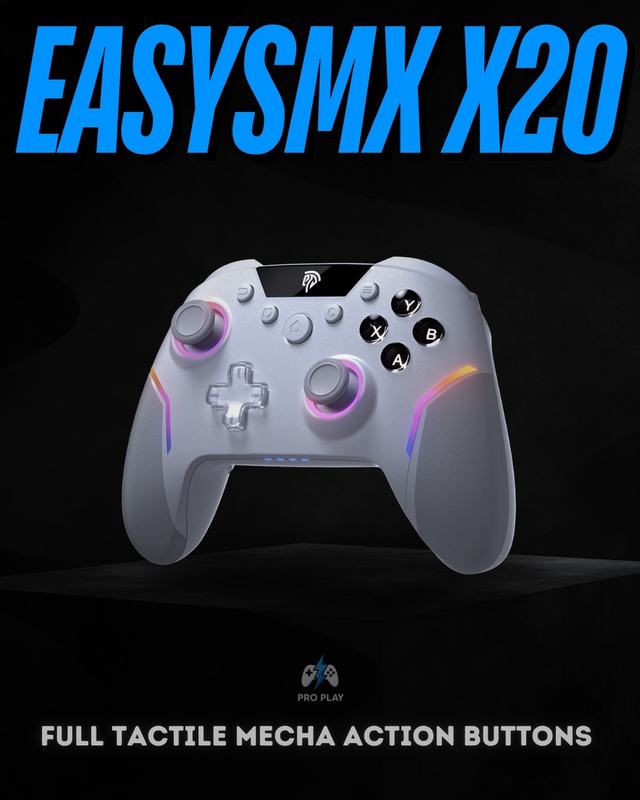
TMR stands for Tunnel Magneto-Resistance. Like Hall Effect, it detects stick movement magnetically, but the sensing principle is different. In controller terms, the appeal is precise magnetic tracking with potentially low power consumption and strong center consistency. The EasySMX X20 uses next-generation TMR sticks, while the EasySMX D-10 also lists TMR joysticks in its current specifications.
View EasySMX X20Will TMR feel better than Hall Effect?
Not automatically. Stick feel depends on more than the sensor. Spring tension, dead-zone tuning, firmware, response curve, thumbstick height and game settings all affect control. A well-tuned Hall Effect controller can feel better than a poorly tuned TMR controller, and vice versa.
- Centering accuracy: how cleanly the stick returns to neutral.
- Dead-zone tuning: how much movement is ignored around the center.
- Outer-range consistency: whether full stick movement maps predictably.
- Firmware calibration: important on magnetic-stick controllers.
- Trigger, button and D-pad quality: these matter just as much as the stick sensor in actual games.
Which technology suits which games?
For racing and sports games, smooth analog control and trigger behaviour may matter more than whether the stick says Hall or TMR. For shooters, clean centering, low dead zones and consistent aim control matter more. The EasySMX X20 also combines TMR sticks with 1000Hz polling, trigger locks and programmable back buttons, while the EasySMX D05 combines Hall sticks with Hall triggers, macros and a charging dock.
For a broader buying guide, read How to Choose a Gaming Controller in Pakistan. You can also browse current gaming controllers and the EasySMX controller range.